

Stacking up the firsts
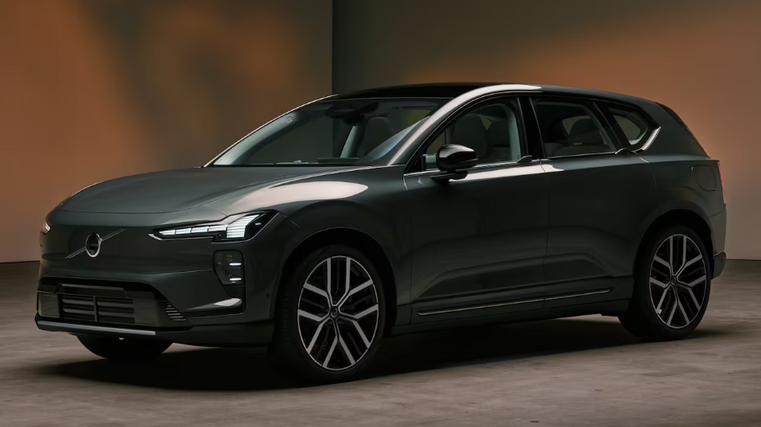
Volvo is continuing its bid to become an electric-only carmaker after the launch of the EX60. It will initially complement the marque’s all-time best-seller, the combustion-powered XC60, before succeeding it.
Chief executive officer Hakan Samuelsson says: “We will become even stronger after we transform to electric.”
He adds the fully electric EX60, a midsize SUV, will be the cornerstone of Volvo’s range. It has an 810km range and the ability to add 340km of range in 10 minutes.
So, what are the “firsts” achieved by the EX60 when it’s launched in mid-2026?
• It’s the first Volvo BEV that can travel more than 800km on a single charge. The WLTP-certified range is 810km. The EPA-certified range in the US is 400 miles.
• The EX60 can add 340km in just 10 minutes, making it the fastest charging BEV in the marque’s line-up. It’s also the brand’s first BEV that can take a charge of up to 400kW.
• The first Volvo to benefit from megacasting, a process that replaces hundreds of smaller parts with a single aluminium casting. This reduces material usage, time and cuts costs. Volvo says material utilisation rises to close to 100 per cent, up from 50 per cent, because nearly all material that comes into the foundry is transformed into cast products. Weight in the rear floor of the EX60 decreases 15 to 20 per cent compared with a rear floor that isn’t created this way.
• The marque’s first BEV to use cell-to-body construction, which integrates the battery pack into the body structure. This makes the battery a load-bearing part of the chassis, contributing to overall stiffness. Volvo says this process improves energy density by 20 per cent, reduces weight and results in a battery that takes up less space. It also charges 31 per cent faster because better integration makes it easier to get electricity to cells.
• The EX60 is the first Volvo to be underpinned by the third generation of its scalable product architecture, SPA3.
• The first Volvo with “pilot assist plus”, which will eventually allow hands-off driving at speeds up to 130kph. At launch, the system will be able to keep the EX60 in its lane and suggest overtaking an oncoming car if needed. A look in the side-view mirror by the driver will indicate to the system it should pass the vehicle ahead. The car will handle the steering and lane changes if the driver’s eyes are on the road.
• Its first model with chipset specialist Qualcomm Technologies’ next-generation Snapdragon Cockpit Platform. The advanced system-on-a-chip provides the highest level of processing power found inside a Volvo to date. This enables ultra-fast responses to the driver and occupants so they can have an AI-powered in-car experience via another first for Volvo – the addition of Google Gemini, the AI assistant.
• The first model capable of more than 250 trillion operations per second, which Volvo says makes the EX60 capable of learning with every kilometre travelled. The vehicle will draw on experiences from other Volvo cars globally, including accidents and near misses.
• The brand’s first model with an adaptive smart seat belt, which it expects to take saving lives to a higher level. Volvo says it better protects people by adapting to traffic variations and the person wearing it thanks to real-time data from advanced sensors.