

Finding value in end-of-life tyres
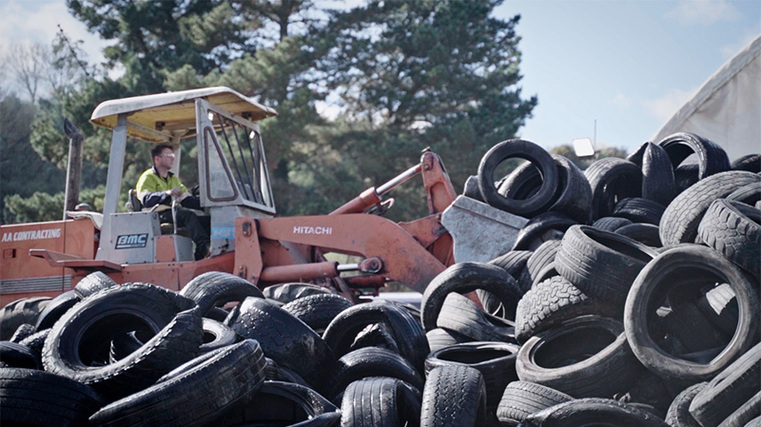
Tyrewise has announced it collected more than 65,700 tonnes of tyres in the year to the end of March 2026.
The total is equivalent to 8.2 million end-of-life tyres and the organisation’s second annual report shows it processed 34,599 tonnes of those into tyre-derived products and fuel.
The report was released on October 21 and is the first to cover a full 12 months of collections after the product stewardship scheme was launched in September 2024.
Adele Rose, chief executive of Tyrewise scheme managers 3R Group, says: “Before Tyrewise the majority of those tyres would’ve been lost to landfill, but now they are contributing to a circular economy which is creating value and jobs in New Zealand.
“Seven months of collections gave us our first annual report. Twelve more have given us something better: a full year of real data on how end-of-life tyres move around Aotearoa, and the feedback of the people who move them.”
Tyrewise’s number of registered partner locations rose from 4,624 to 5,444 in the year covered by the report, public collection sites increased by 26.7 per cent to 109, and a survey found public positivity towards the scheme grew from 66 per cent to 77 per cent.
Some 424 vehicle importers, 998 vehicle sellers, 306 tyre importers and 4,235 tyre retailers and fitters were among the businesses who participated in the scheme in the year to the end of March.
“The survey results in the report matter to us as much as the tonnages,” adds Rose.
“Registered partners told us they understand the scheme, feel confident in their roles and rate their transporters highly.
“Tyre consumers who know about Tyrewise increasingly understand it, and more of them say they recycle their tyres. Those are the foundations a stewardship scheme is built on.”
She notes the scheme is designed to be data-rich, tracking everything from how many tyres enter the country to how many are collected at end of life, and what happens to them.
That and other information aims to make the scheme more efficient and sustainable, both economically and environmentally.
“For example, when conflict in the Middle East pushed fuel prices up sharply, the data let us analyse the real effect on transporters’ costs and respond with evidence rather than guesswork,” says Rose.
Looking ahead
Mark Gilbert, chair of Auto Stewardship New Zealand (ASNZ), the product stewardship organisation and governing body for Tyrewise, says the board of trustees’ focus shifted over the past year.
“With the network established, our next task is to build the domestic market for what it collects,” he explains.
“In June 2025, Puna Taurima, the Tyrewise Fund, opened for expressions of interest and drew strong interest in its first round.”
A grants committee was established and 33 formal applications were considered, with finalisation of contracts for successful applications ongoing at the end of the reporting period.
The annual report says rubber in roading is a strong focus for the scheme going forward, as it represents the most immediate, high-value pathways to create circular solutions for tyres.
An action plan, commissioned from engineering and professional services consulting firm WSP, looks to remove the barriers to market uptake of 16,000 to 18,000 tonnes of rubber-modified bitumen in the nation’s roads.
The plan forms the backbone of the scheme’s engagement with roading stakeholders and helped shape Puna Taurima.
Other areas of work going forward include increasing transport efficiencies, forming a working group on retreading, and a refreshed risk framework built on real-world experience.
Rose says: “From where we stand, the picture is this: the network runs, the people in it are engaged, and the next stage is about value.”